
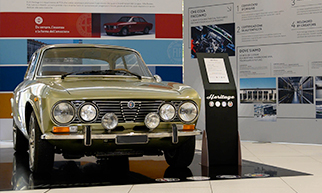


From the original, elegant 1979 hatchback to the star of rallies in the 1980s and ’90s: the Lancia Delta marks the brand's return to the premium compact segment, combining comfort, technical innovation and an increasingly broad, sporty range.
Debut in Frankfurt
At its launch at the Frankfurt Motor Show in autumn 1979, the Lancia Fulvia stood as much more than a new compact saloon car: it marked the return to a segment the brand had left in 1972 with the exit of the saloon version of the Lancia Fulvia. Although the small two-door Lancia Fulvia Coupé 1.6 HF sports car had remained in production until 1976 thanks to its glorious victory at the Monte Carlo Rally in January 1972, otherwise in the ’70s Lancia focused its new range on higher category models such as the Gamma and Beta, leaving a temporary gap in the prestige compact range.
Compact yet refined
The Lancia Delta was therefore created with a specific objective in mind: to transfer the refined, technical and elegant image typical of the Chivasso manufacturer to smaller cars. It was also a major project from an industrial perspective: the new model took advantage of some of the experience gained with the Beta, especially in terms of its chassis and mechanical specifications, while adopting an all-new and modern bodywork, known in English-speaking countries as the ‘hatchback’.
Design by Giugiaro
The Lancia Delta style was created by Giorgetto Giugiaro and his Italdesign firm. The lines were compact but highly personal, featuring taut, rational geometric shapes, a design that would be carried over to production in the years that followed. The five-door hatchback managed to combine elegance and practicality: large surfaces, slim pillars and an almost vertical tail made it more spacious than the category average. The clean, understated front introduced a stylistic language that would later be taken up by other 1980s Lancias.
High-end
At just over four metres long, the Lancia Delta made an immediate impact for its ‘high-end’ specifications. The interior stood out for its meticulous finishes, refined soft-touch materials, very comfortable seats and thorough soundproofing. The dashboard and upholstery were reminiscent of the style of higher-end Lancias, resulting in a quality perceived to be greater than usual in the compact segment. The car's focus was more on comfort and perceived quality than on pure sportiness.


A successor to the Beta
From a technical point of view, the Delta inherited several of its components from the Lancia Beta. The McPherson front suspension scheme and independent rear axle were drawn from the experience gained from the medium-sized saloon, but adapted for a smaller, lighter car. It adopted front-wheel drive, by then a consolidated solution within the Fiat-Lancia Group, whereas its platform was also made to be taken on by the upcoming Saab 600, a version intended for the Scandinavian market. The Delta was notable from the outset for its balanced behaviour on the road, for its safety at high speeds and comfort in everyday use. A great deal of attention was also paid to passive safety and ergonomics, focused on strongly in Lancia's commercial communications for the model.
Initial engines and range
At launch, the Delta was available with engines originally from Fiat: an evolution of the glorious Lampredi twin-cam, revisited with a Lancia flair. The initial range included the 75-hp 1.3-litre unit and the 85-hp 1.5, both with five-speed manual transmission, a solution rarely seen in the segment at that point. In 1980 came the elegant LX trim level, flanked by the 1.5 with automatic transmission, which took the Turin compact car to higher levels of comfort and refinement. Its commercial success was immediate, topped off by the Car of the Year 1980 award, won by the Delta for its balance between innovation, comfort and construction quality.
Creation of the GT and return of the HF brand
In 1982, the range was expanded with the Delta GT 1.6, a version with a more brilliant character that introduced a more marked dynamic connotation. Above all though, 1983 was the key year in the model's sporting history. The launch of the Lancia Delta HF Turbo marked the return of the renowned HF brand, after an absence from Lancia models since the days of the Lancia Stratos . Even ahead of the Integrale versions' arrival, the letters “HF” thus reappeared on a Delta that retained front-wheel drive, designed to combine high performance and everyday use.


HF Turbo
The Delta HF Turbo adopted a 1.6-litre four-cylinder supercharged by a Garrett turbocharger, initially delivering 130 hp. Its performance was highly significant for the time, with a top speed of over 190 km/h. Aesthetically, it stood out for its specific rims, more pronounced wheel arches, aerodynamic details and sportier interior, while maintaining the brand's typical elegance. Later, with the adoption of electronic injection, the output of the Lancia Delta 1.6 (Turbo HF) rose to 140 hp, or 132 hp in the version with a catalytic converter.
LMid-’80s developments in the range
In the 1980s, the Delta progressively evolved both technically and stylistically, with updates to the engines, new trim levels and continuous improvements in interior finishes. In 1986 came the first major restyling: the bumpers, grille and passenger compartment details were altered, whereas the engine range received a further update to improve fuel consumption and emissions. Versions with electronic injection and catalytic converter also made their debut, in line with changes in EU regulations.
Stars in rallying
Alongside the more markedly sporty versions, from the Lancia Delta S4 to theLancia Delta HF 4WD e Integrale that would go on to make rallying history, the hatchback continued to be appreciated most of all as a classy compact saloon car that could offering superior comfort, road holding and perceived quality compared to many of its generalist competitors.
The 1990s Delta
In 1991, while the Integrale evolutions continued to convey not only the range’s but also the Group's sporty image, the traditional Delta reached the final stages of its commercial career. Although updated over time, Giorgetto Giugiaro's original lines maintained their powerful personality, a sign of the validity of the initial project and its creation of timeless stylistic features.


An indelible mark
In over a decade of production, the first Delta managed to epitomise the Lancia philosophy of the 1980s, by combining elegance, technical innovation and comfort in a compact car with an exclusive image. Alongside the sporting successes of the HF Integrale versions, the model also proved its ability to build a solid reputation as a refined, technologically advanced premium saloon car, one that left an indelible mark on automotive history, in Italy and beyond.